Choosing between Cat6 and Cat6A is one of the most common decisions in a structured cabling project. Both categories use familiar twisted-pair copper cabling and RJ45 connectivity, but they are designed for different performance targets, installation conditions and long-term network requirements.
For a standard office running mainly at 1 Gigabit Ethernet, Cat6 can be a practical and cost-effective choice. For projects that require reliable 10 Gigabit Ethernet over longer horizontal runs, higher bandwidth, or greater headroom for future upgrades, Cat6A is usually the stronger option.
This guide compares Cat6 vs Cat6A by bandwidth, Ethernet speed, distance, cable size, installation, PoE considerations, cost and common applications so you can make a better decision for your network project.
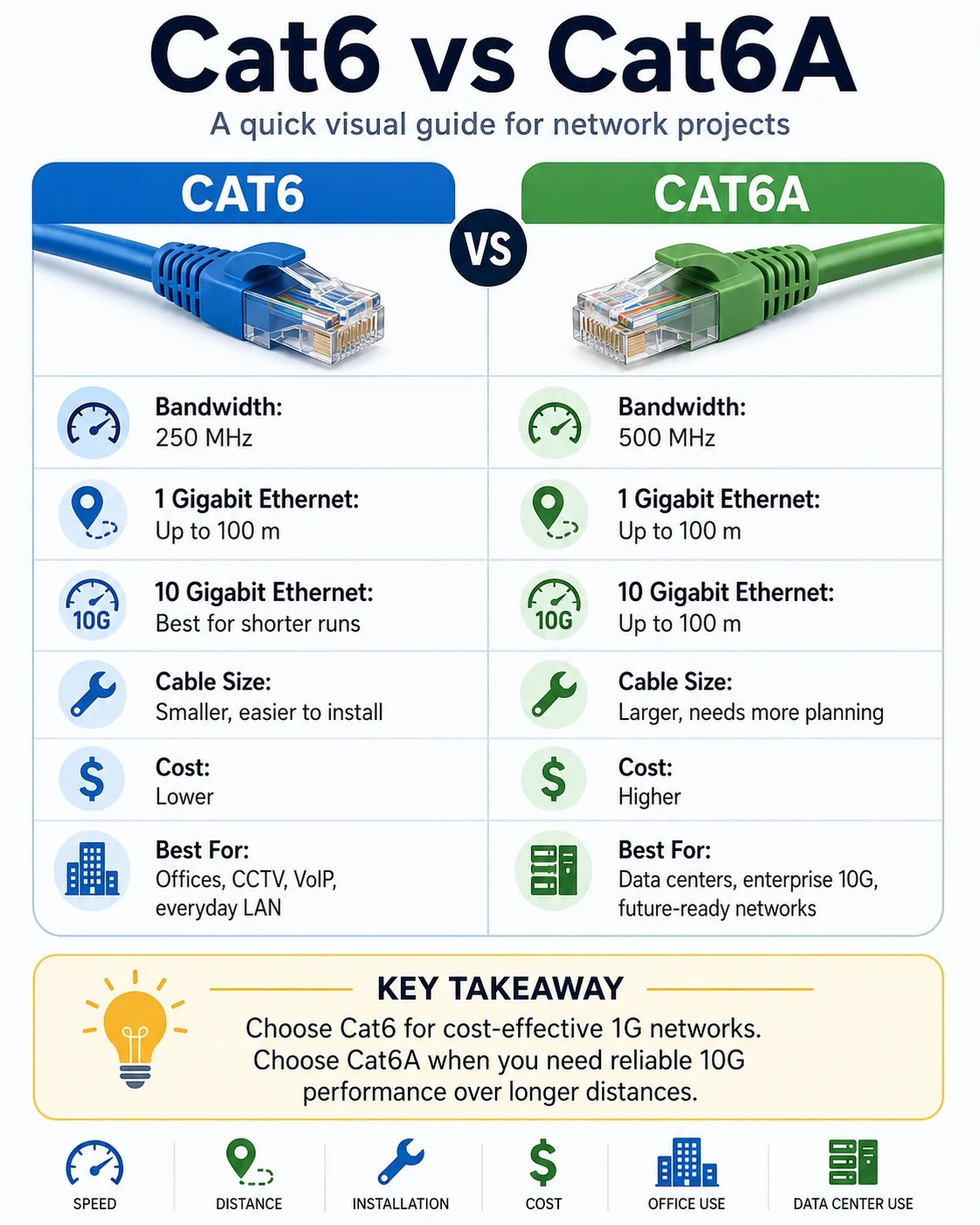
Cat6 vs Cat6A: Quick Comparison
| Feature | Cat6 | Cat6A |
|---|---|---|
| Specified Frequency | Up to 250 MHz | Up to 500 MHz |
| 1 Gigabit Ethernet | Up to 100 m channel | Up to 100 m channel |
| 10 Gigabit Ethernet | Best suited to shorter runs; supported distance depends on channel and installation conditions | Designed to support 10GBASE-T up to a 100 m channel |
| Cable Size | Typically smaller and more flexible | Typically larger and more demanding to route |
| Installation | Generally easier | Requires more pathway and termination planning |
| Relative Cost | Usually lower | Usually higher |
| Typical Applications | Offices, CCTV, VoIP, general LAN | Data centers, enterprise 10G, high-performance access networks |
What Is Cat6 Cable?
Category 6 (Cat6) is a balanced twisted-pair cabling category widely used in commercial buildings, offices, schools, retail networks, surveillance systems and residential installations. It is specified to 250 MHz and supports Gigabit Ethernet over the standard 100-meter channel when the complete cabling system is designed and installed correctly.
Cat6 can also support 10 Gigabit Ethernet over shorter distances. The practical 10G distance depends on the complete channel, the installation environment and crosstalk conditions. This is why Cat6 is commonly selected when most network connections operate at 1G and full-distance 10G is not a project requirement.
Common Cat6 Applications
- Office workstations
- IP cameras and CCTV networks
- VoIP phones
- Printers and general network devices
- Standard wireless access point connections
- Retail and education networks
- Small server rooms
- Residential LAN installations
For many day-to-day business networks, Cat6 offers a useful balance of performance, installation flexibility and material cost.
What Is Cat6A Cable?
Category 6A (Cat6A) was developed to extend twisted-pair copper performance for 10 Gigabit Ethernet. It is specified to 500 MHz and is designed to support 10GBASE-T over a full 100-meter channel.
Cat6A also places greater emphasis on controlling alien crosstalk between adjacent cables. As a result, Cat6A cable and connecting hardware are often larger or more robust than Cat6 components.
Common Cat6A Applications
- Enterprise 10 Gigabit Ethernet
- Data centers and equipment rooms
- High-performance server connections
- High-bandwidth wireless access points
- Long horizontal copper runs requiring 10G
- New commercial buildings designed for future bandwidth growth
Cat6 vs Cat6A Speed, Distance and Bandwidth
The most important technical difference between Cat6 and Cat6A is not that Cat6A automatically makes every network faster. Network speed is determined by the complete system: switches, network interface cards, patch panels, keystone jacks, patch cords, permanent links and the quality of the installation.
The key difference is the performance margin available to support higher-speed Ethernet.
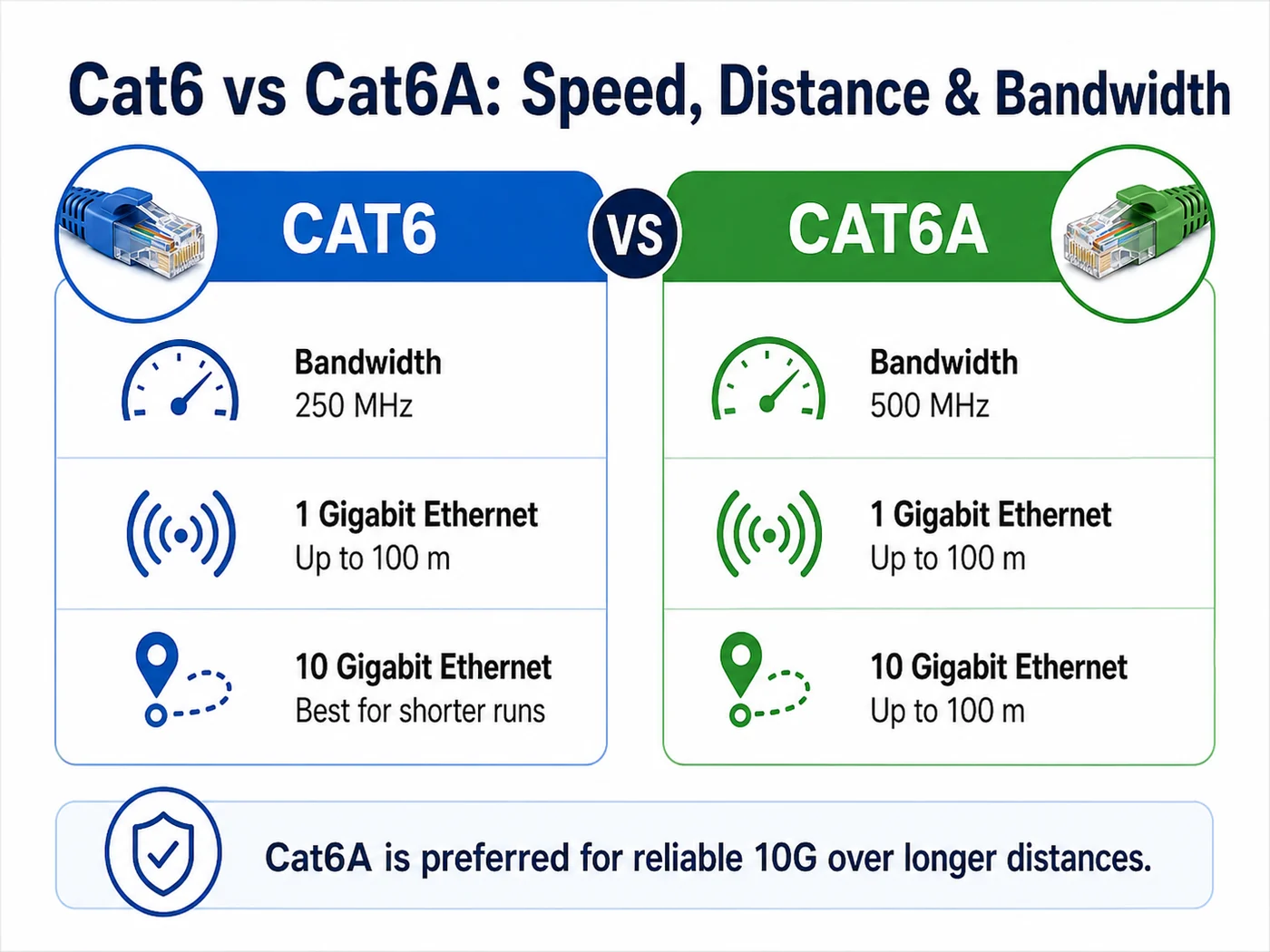
- Cat6: specified to 250 MHz and widely used for 1G networks up to 100 m.
- Cat6A: specified to 500 MHz and designed to support 10GBASE-T over a 100 m channel.
Does Cat6A Make a 1G Network Faster?
No. If your switch, computer and other active equipment operate at 1 Gbps, replacing Cat6 with Cat6A will not make that connection exceed the capability of the active equipment.
Cat6A becomes more valuable when the project requires 10G, longer copper runs at high speed, increased interference control or infrastructure expected to remain in service through future network upgrades.
Cat6 vs Cat6A Cable Construction
Cat6 and Cat6A are both available in different cable constructions, including unshielded and shielded options. The exact outside diameter, conductor size and internal separator design vary by manufacturer and cable model, so category alone should not be used to estimate cable dimensions.
In general, Cat6A cables tend to be larger because the construction must maintain performance at higher frequencies and control crosstalk. This can affect:
- Conduit fill
- Cable tray capacity
- Minimum bend radius
- Bundle size
- Patch panel density
- Termination and cable-management space
Cat6 UTP vs Cat6A UTP
UTP means unshielded twisted pair. Cat6 UTP is extremely common because it is flexible, economical and straightforward to terminate in normal commercial environments.
Cat6A UTP provides higher category performance without requiring a shielded channel, but it often uses a larger cable construction to manage alien crosstalk. When planning a large Cat6A UTP installation, pathway capacity and cable management should be checked before procurement.
Cat6A Shielded Cable
Cat6A is also widely available in shielded constructions such as F/UTP and other screened designs. Shielding can be useful in environments with higher electromagnetic interference or where the project specification requires a shielded cabling system.
However, a shielded cable should be treated as part of a complete shielded channel. Patch panels, jacks, patch cords, bonding and grounding practices should all match the system design. Simply installing a shielded cable does not guarantee better performance if the complete channel is not implemented correctly.
Cat6 vs Cat6A for PoE
Both properly designed Cat6 and Cat6A cabling systems can be used for Power over Ethernet applications. PoE is commonly used for:
- IP surveillance cameras
- Wireless access points
- VoIP phones
- Access control equipment
- IoT devices
- Building automation
For higher-power PoE and large cable bundles, cable construction becomes increasingly important. Conductor material, conductor size, resistance, bundle temperature, ambient temperature and installation conditions should all be considered.
For professional projects, avoid choosing a cable only because the jacket says “Cat6” or “Cat6A.” The actual electrical construction, standards compliance and test performance matter just as much.
Where Should You Use Cat6 and Cat6A?
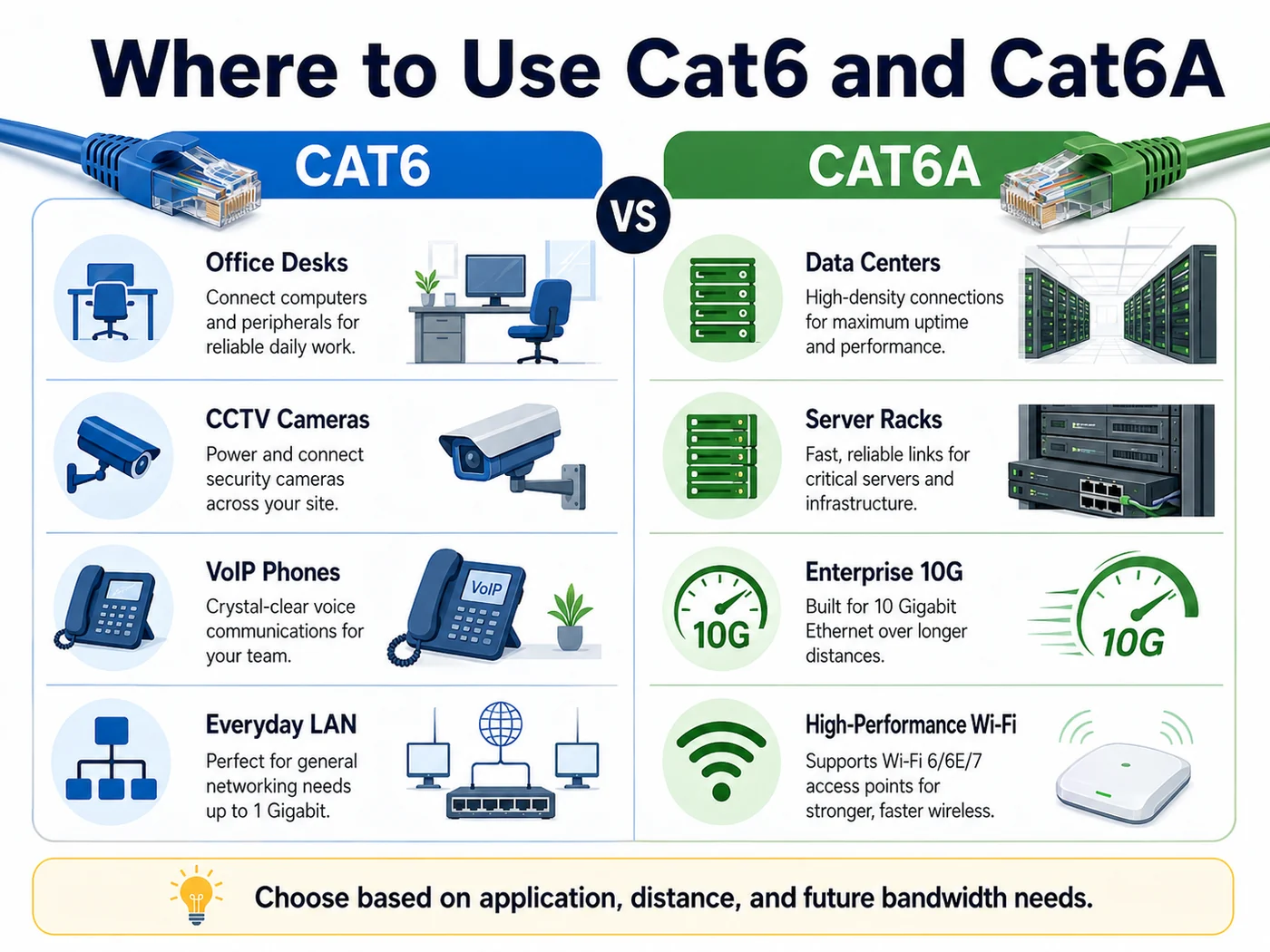
Choose Cat6 for Standard Office Networks
Cat6 is often the practical choice when the majority of devices operate at 1G and the project does not require full-distance 10G copper links. It is commonly used for PCs, printers, phones, cameras and other normal endpoints.
Choose Cat6A for Data Centers and Enterprise 10G
Cat6A is a stronger fit when a project requires reliable 10GBASE-T across longer horizontal cable runs. It is also useful in new-build projects where replacing horizontal cabling later would be disruptive or expensive.
Choose Based on the Whole Network, Not One Device
A structured cabling system should be planned as a channel. The permanent cable is only one part. Patch panels, keystone jacks, patch cords, cabinets and active equipment must all be appropriate for the performance target.
Cat6 vs Cat6A Installation
Cat6 is normally easier to route and terminate because the cable is typically smaller and more flexible. Cat6A may require greater attention to bend radius, cable dressing, bundle size and pathway space.
On a large installation, those differences can affect labor and infrastructure. Before converting an entire Cat6 specification to Cat6A, confirm:
- Cable tray and conduit capacity
- Rack and cabinet cable-management space
- Patch panel density
- Maximum bundle sizes
- Termination method
- Testing requirements
- Installer familiarity with the selected system
Cat6 vs Cat6A Cost
Cat6 is usually less expensive at the material level. Cat6A cable, jacks and patch panels may cost more, and installation can require additional pathway or labor planning.
However, the lowest initial cable price is not always the lowest total project cost. Horizontal cabling can remain inside a building for many years. If a network is likely to migrate to 10G during that period, replacing installed cable later may cost far more than selecting a higher-performance category at the beginning.
For this reason, project cost should be evaluated over the expected life of the infrastructure, not only by comparing the price per box or meter of cable.
Should You Choose Cat6 or Cat6A?
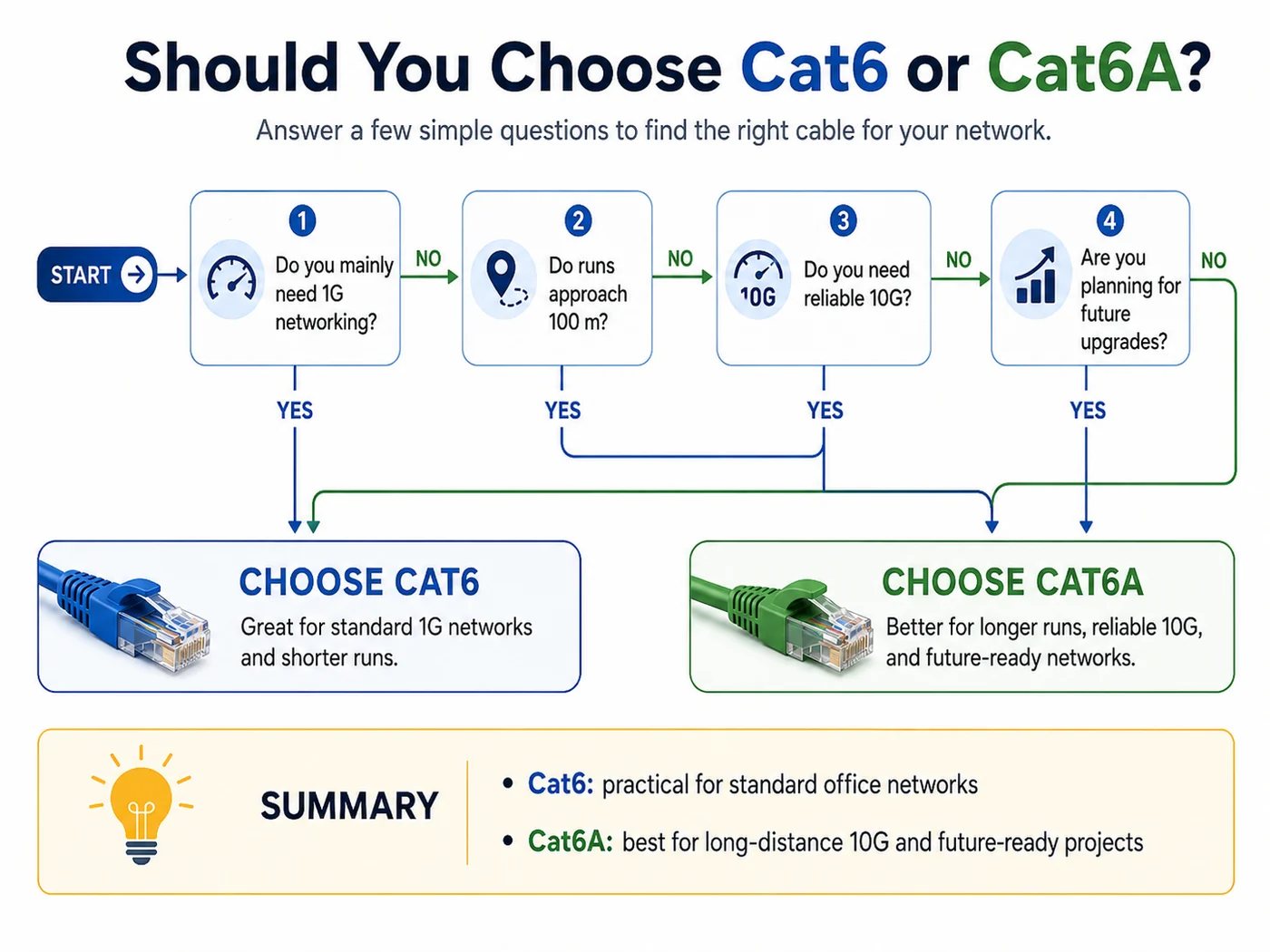
Choose Cat6 When:
- Your network mainly operates at 1 Gigabit Ethernet
- Budget efficiency is important
- Cable pathways have limited space
- Installation flexibility is a priority
- You do not need 10G over long horizontal runs
- The project is a standard office, CCTV, VoIP or general LAN installation
Choose Cat6A When:
- You require reliable 10 Gigabit Ethernet over longer runs
- The project includes data centers or enterprise server infrastructure
- You expect higher bandwidth requirements in the future
- The cabling will remain installed for many years
- You are deploying high-performance access points or other bandwidth-intensive devices
- The cost of replacing horizontal cabling later would be high
Cat6 vs Cat6A for New Commercial Buildings
For a new building, the decision should be based on how long the structured cabling is expected to remain in service. Active electronics can be replaced relatively easily, while horizontal cabling inside ceilings, walls and pathways is much harder to upgrade.
If the project is designed around standard 1G endpoints and cost is a major constraint, Cat6 may still be the right choice. If the building is expected to support higher-speed access points, enterprise applications or 10G connections over time, Cat6A can provide more headroom.
Can You Mix Cat6 and Cat6A Components?
Physically, many Cat6 and Cat6A components use the same RJ45 interface, but the performance of the channel is determined by the complete set of installed components.
If Cat6A cable is terminated through lower-category connecting hardware, you should not assume the channel will meet Cat6A performance. For a specified Cat6A channel, use compatible Cat6A cable, jacks, patch panels and patch cords and test the completed installation to the required category.
Frequently Asked Questions
Is Cat6A better than Cat6?
Cat6A offers higher specified bandwidth and full-distance 10G capability, but that does not mean it is automatically the best choice for every project. Cat6 may be more practical for standard 1G networks where cost, cable size and installation simplicity are more important.
Can Cat6 support 10 Gigabit Ethernet?
Yes. Cat6 can support 10GBASE-T over shorter distances, but the supported distance depends on the installed channel and crosstalk conditions. Cat6A is specifically designed for 10GBASE-T over a full 100-meter channel.
Is Cat6A always shielded?
No. Cat6A is available in both unshielded and shielded constructions. The best choice depends on the environment, project specification and grounding/bonding design.
Is Cat6A harder to install?
It can be. Cat6A cable is often larger and less flexible than Cat6, so it may require more pathway space, careful bend management and additional attention during termination.
Is Cat6 enough for CCTV?
For many IP CCTV systems, Cat6 provides more than enough data bandwidth. The project should also consider PoE power, conductor size, cable length, environment and the number of cables bundled together.
Is Cat6A worth the extra cost?
Cat6A can be worth the additional cost when a project requires full-distance 10G or when the cabling is expected to remain in service through future network upgrades. For a basic 1G installation with no long-term 10G requirement, Cat6 may provide better value.
Final Takeaway
There is no single winner in the Cat6 vs Cat6A comparison. The right choice depends on the network’s required speed, cable length, installation environment, project budget and expected service life.
Choose Cat6 for cost-effective 1G networks, normal office endpoints, CCTV, VoIP and general LAN applications.
Choose Cat6A when you need reliable 10G over longer distances, higher bandwidth headroom or a more future-ready structured cabling platform.
For commercial projects, evaluate the complete channel rather than the cable alone. Cable, patch panels, keystone jacks, patch cords, cabinets and installation quality all contribute to final network performance.
Need Help Choosing Cat6 or Cat6A for Your Project?
QGreenLink supplies structured cabling and fiber optic connectivity solutions for distributors, installers and project procurement. Send us your required cable category, quantity, transmission distance and application, and our team can help you prepare the right cabling solution and quotation.
Tip: Include your project quantity, required cable type, UTP or shielded construction, jacket requirement and destination market when requesting a quotation.
Contact QGreenLink on WhatsApp for project sourcing support.