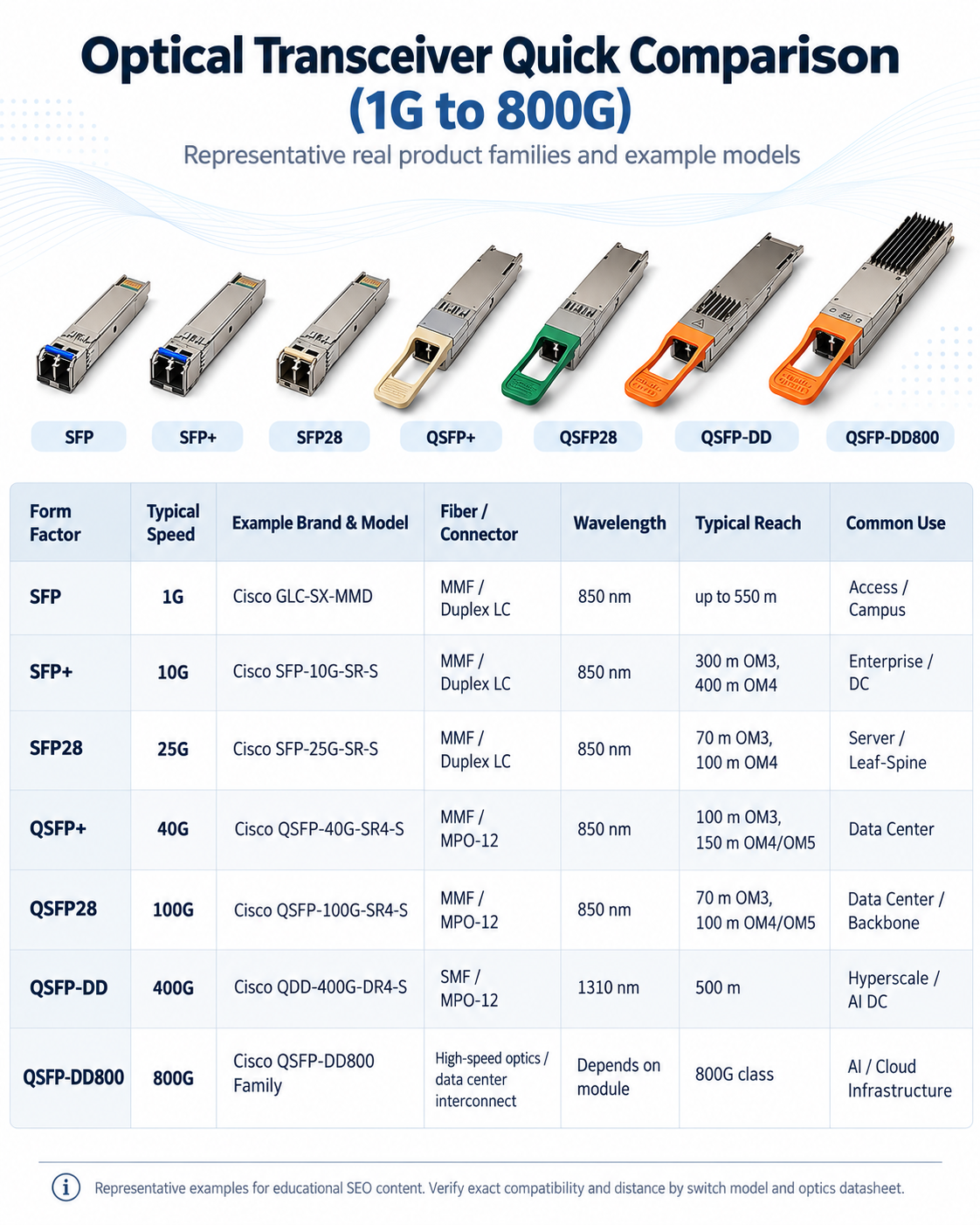
Optical transceivers are the small pluggable modules that connect switches, routers, servers and storage systems to fiber-optic networks. As Ethernet has evolved from 1G to 10G, 25G, 40G, 100G, 400G and 800G, the form factors, connector types and optical standards have evolved with it.
This guide explains the most common SFP, SFP+, SFP28, QSFP+, QSFP28, QSFP-DD and OSFP families, using real product examples and practical selection data. It is designed for enterprise networks, data centers, telecom projects and AI infrastructure buyers who need a fast way to compare speed, fiber type, wavelength, reach and compatibility.
What Is an Optical Transceiver Module?
An optical transceiver module is a pluggable device that converts electrical signals from network equipment into optical signals for fiber transmission and converts received optical signals back into electrical data. The right module matches the host port, Ethernet speed, fiber type, wavelength, connector and required reach.
Optical Transceiver Evolution at a Glance
| Form Factor | Typical Speed | Typical Optical Standard | Common Connector | Typical Use |
|---|---|---|---|---|
| SFP | 1G | 1000BASE-SX / LX | Duplex LC | Access, campus, enterprise |
| SFP+ | 10G | 10GBASE-SR / LR / ER | Duplex LC | Enterprise and data center |
| SFP28 | 25G | 25GBASE-SR / LR | Duplex LC | Server-to-switch, leaf-spine |
| QSFP+ | 40G | 40GBASE-SR4 / LR4 | MPO-12 or LC | Data center aggregation |
| QSFP28 | 100G | 100GBASE-SR4 / LR4 / CWDM4 | MPO-12 or LC | Backbone and data center |
| QSFP-DD | 400G / 800G | DR4 / FR4 / SR8 and related families | MPO / LC depending on module | Hyperscale and AI data centers |
| OSFP | 400G / 800G | DR4 / DR8 / FR4 and related families | MPO / LC depending on module | AI clusters and high-density switching |
1G SFP: The Classic Access-Layer Optical Module
SFP stands for Small Form-factor Pluggable. It remains one of the most widely deployed optical module formats in campus networks, industrial Ethernet, CCTV networks and enterprise access layers.

A representative 1G example is GLC-SX-MMD 1000BASE-SX, commonly associated with 850 nm multimode links for short-reach enterprise and campus deployments.
| Example Model | Speed | Fiber | Wavelength | Connector | Typical Reach |
|---|---|---|---|---|---|
| Cisco GLC-SX-MMD | 1G | MMF | 850 nm | Duplex LC | Up to 550 m depending on fiber grade |
10G SFP+: SR vs LR
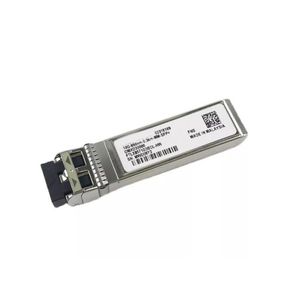
SFP+ became the dominant compact form factor for 10 Gigabit Ethernet. The two most common variants are 10GBASE-SR for short multimode links and 10GBASE-LR for longer single-mode links.
10GBASE-SR
850 nm, multimode fiber, typically used inside data centers and equipment rooms.
10GBASE-LR
1310 nm, single-mode fiber, typically used for longer enterprise, campus and metro links.
| Model Example | Standard | Fiber | Wavelength | Connector | Typical Reach |
|---|---|---|---|---|---|
| SFP-10G-SR | 10GBASE-SR | MMF | 850 nm | Duplex LC | About 300 m on OM3, 400 m on OM4 |
| Cisco SFP-10G-LR-S | 10GBASE-LR | SMF | 1310 nm | Duplex LC | 10 km |
25G SFP28: Higher Density for Modern Servers
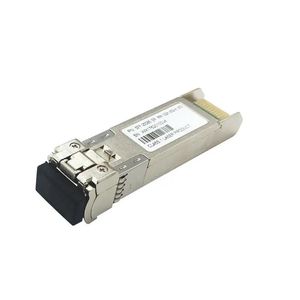
SFP28 increases a single-lane link from 10G to 25G while keeping a compact form factor. It is widely used between servers and top-of-rack switches in leaf-spine data center architectures.
| Representative Model | Speed | Fiber | Wavelength | Connector | Typical Reach |
|---|---|---|---|---|---|
| SFP-25G-SR | 25G | MMF | 850 nm | Duplex LC | 70 m OM3 / 100 m OM4 |
40G QSFP+: Four-Lane Optical Networking
QSFP+ introduced four-lane 40G connectivity. Short-reach SR4 modules usually use MPO/MTP parallel fiber, while LR4 modules typically use wavelength multiplexing over duplex LC single-mode fiber.
| Model Example | Speed | Optical Type | Fiber | Connector | Typical Reach |
|---|---|---|---|---|---|
| Cisco QSFP-40G-SR4-S | 40G | SR4 | MMF | MPO-12 | 100 m OM3 / 150 m OM4 or OM5 |
| QSFP-40G-LR4 | 40G | LR4 | SMF | Duplex LC | Up to 10 km for standard LR4 implementations |
100G QSFP28: A Mainstream Data Center Standard

QSFP28 became one of the most important 100G form factors for cloud, enterprise backbone and data center interconnect applications.
| Model Example | Standard | Fiber | Connector | Reach | Best Fit |
|---|---|---|---|---|---|
| QSFP-100G-SR4 | 100GBASE-SR4 | MMF | MPO-12 | 70 m OM3 / 100 m OM4 | Data center short reach |
| Cisco QSFP-100G-LR4-S | 100GBASE-LR4 | SMF | Duplex LC | 10 km | Backbone / DCI |
400G and 800G: QSFP-DD and OSFP for AI Infrastructure
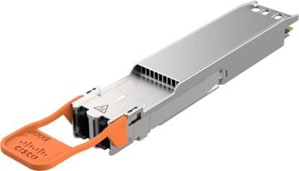
As AI training clusters and hyperscale data centers increase east-west traffic, 400G and 800G interfaces are becoming more important. QSFP-DD and OSFP provide the electrical lane density and thermal design needed for high-bandwidth optical links.
| Form Factor | Common Speed | Example Family | Typical Fiber | Common Use |
|---|---|---|---|---|
| QSFP-DD | 400G | 400G DR4 / FR4 / SR8 | SMF or MMF depending on optic | Hyperscale data center |
| QSFP-DD800 | 800G | 800G DR8 / 2xFR4 families | SMF or MMF depending on optic | AI and cloud interconnect |
| OSFP | 800G | Cisco OSFP-800G-DR8 example | SMF | AI switching and GPU fabrics |
SR, LR, ER and ZR: What Do the Letters Mean?
| Code | Meaning | Typical Fiber | Typical Scenario |
|---|---|---|---|
| SR | Short Reach | Multimode | Rack, room or data hall |
| LR | Long Reach | Single-mode | Campus, backbone, longer data center links |
| ER | Extended Reach | Single-mode | Metro and extended links |
| ZR | Very long-reach family; meaning depends on Ethernet generation | Single-mode | Long-distance and coherent DCI in newer generations |
LC vs MPO/MTP Connectors
Duplex LC normally carries one transmit fiber and one receive fiber. MPO/MTP is a multi-fiber connector used by parallel-optics standards such as many SR4, DR4 and SR8 implementations.
| Connector | Fiber Count | Typical Modules | Key Advantage |
|---|---|---|---|
| Duplex LC | 2 fibers | 1G LX, 10G LR, 40G LR4, 100G LR4 | Simple and widely deployed |
| MPO/MTP | Multiple fibers | 40G SR4, 100G SR4, 400G DR4/SR8 families | High-density parallel optics |
Single-Mode vs Multimode Fiber
| Fiber Type | Common Grades | Typical Reach | Typical Optics |
|---|---|---|---|
| Multimode Fiber | OM3 / OM4 / OM5 | Short to medium data-center links | SR / SR4 / SR8 |
| Single-Mode Fiber | OS2 | Hundreds of meters to many kilometers | LR / ER / DR / FR / coherent families |
Real-World Model Comparison
The table below summarizes representative branded models and commonly used standards. Exact supported distance, FEC requirements, DOM/DDM behavior and platform compatibility should always be checked against the switch and transceiver datasheets.
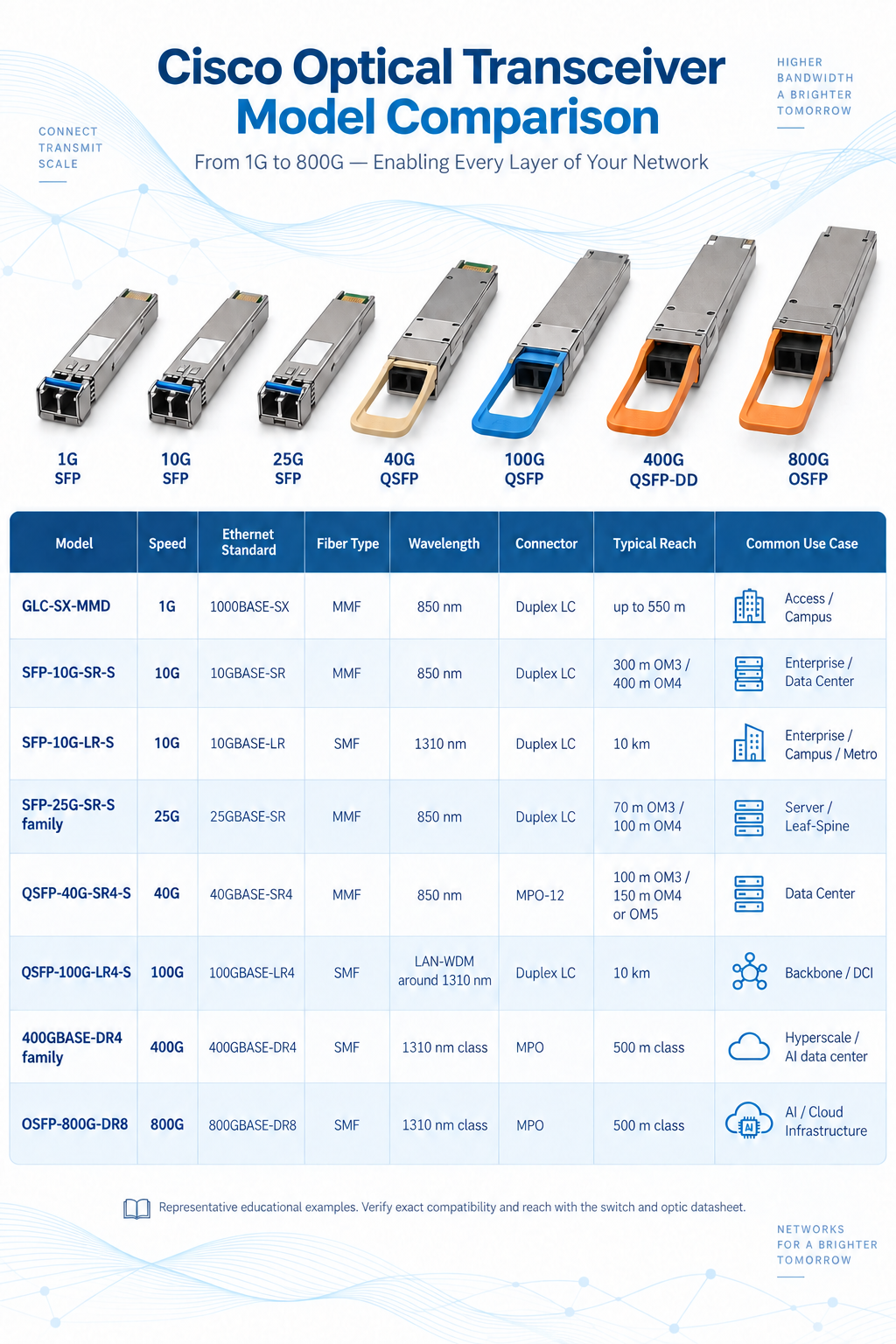
| Brand / Model Example | Speed | Type | Fiber | Wavelength | Connector | Typical Reach |
|---|---|---|---|---|---|---|
| Cisco GLC-SX-MMD | 1G | 1000BASE-SX | MMF | 850 nm | LC | Up to 550 m depending on fiber |
| Cisco SFP-10G-SR-S | 10G | 10GBASE-SR | MMF | 850 nm | LC | 300 m OM3 / 400 m OM4 |
| Cisco SFP-10G-LR-S | 10G | 10GBASE-LR | SMF | 1310 nm | LC | 10 km |
| Cisco SFP-25G-SR-S family | 25G | 25GBASE-SR | MMF | 850 nm | LC | 70 m OM3 / 100 m OM4 |
| Cisco QSFP-40G-SR4-S | 40G | 40GBASE-SR4 | MMF | 850 nm | MPO-12 | 100 m OM3 / 150 m OM4 or OM5 |
| Cisco QSFP-100G-LR4-S | 100G | 100GBASE-LR4 | SMF | LAN-WDM around 1310 nm | LC | 10 km |
| 400G DR4 family | 400G | 400GBASE-DR4 | SMF | 1310 nm class | MPO | 500 m class |
| Cisco OSFP-800G-DR8 | 800G | 800GBASE-DR8 | SMF | 1310 nm class | MPO | 500 m class |
Why Two Modules with the Same Label Can Perform Differently
Two modules may both say “10G 1310 nm 10 km LC” but still differ in component quality, laser source, receiver sensitivity, EEPROM coding, temperature range, optical power stability, production yield and compatibility testing. For large deployments, these differences can affect link stability and failure rates.
What Are DDM and DOM?
Digital Diagnostic Monitoring (DDM), also called Digital Optical Monitoring (DOM), allows supported switches to read module telemetry such as temperature, supply voltage, transmit optical power, receive optical power and laser bias current. These values are useful when troubleshooting dirty connectors, excessive link loss, aging optics and marginal fiber paths.
| DOM/DDM Parameter | What It Helps Diagnose |
|---|---|
| Temperature | Thermal stress and cooling issues |
| Voltage | Power stability |
| TX Optical Power | Transmitter output condition |
| RX Optical Power | Fiber loss, contamination or weak signal |
| Laser Bias Current | Laser operating condition and aging indicators |
What Is a Compatible Optical Transceiver?
A compatible optical transceiver is a third-party module programmed and tested to work with a specific switch or router platform. Compatibility is not determined only by the printed model name. EEPROM coding, host platform, operating system, port configuration and optical standard all matter.
Before ordering, provide the switch brand, switch model, port speed, required distance, fiber type and connector type. That is much more useful than simply asking for “a 10G LR module.”
8 Parameters to Confirm Before Buying an Optical Module
| # | Parameter | Examples |
|---|---|---|
| 1 | Speed | 1G, 10G, 25G, 40G, 100G, 400G, 800G |
| 2 | Form Factor | SFP, SFP+, SFP28, QSFP28, QSFP-DD, OSFP |
| 3 | Fiber Type | Single-mode or multimode |
| 4 | Distance | 100 m, 500 m, 2 km, 10 km, 40 km, 80 km |
| 5 | Connector | LC, MPO/MTP |
| 6 | Wavelength | 850 nm, 1310 nm, 1550 nm, CWDM, DWDM |
| 7 | Host Compatibility | Cisco, HPE, Juniper, Arista, Huawei, MikroTik and others |
| 8 | Operating Environment | Commercial or industrial temperature |
FAQ
What does an optical transceiver module do?
It converts electrical signals to optical signals for fiber transmission and converts received optical signals back to electrical data. The host port, speed, fiber, wavelength, connector and reach must all match.
Is SFP+ the same as SFP?
No. SFP is commonly used for 1G Ethernet, while SFP+ is commonly used for 10G. They share a similar physical size, but the host port and protocol support still need to be checked.
What is the difference between SR and LR?
SR normally targets short-reach multimode links, while LR generally targets longer single-mode links. The exact distance depends on the Ethernet standard, fiber grade and module specification.
Should I use single-mode or multimode fiber?
Use multimode for many short data-center links when the installed OM3, OM4 or OM5 plant and SR optic are appropriate. Use single-mode for longer links or when the design calls for LR, ER, DR, FR or other single-mode optics.
What are DOM and DDM on an optical module?
Digital Optical Monitoring (DOM), also called Digital Diagnostic Monitoring (DDM), exposes telemetry such as temperature, voltage, transmit power, receive power and laser bias current when the module and host support it.
Can a Cisco-compatible or third-party transceiver work in my switch?
It can when its coding, optical standard, port speed, firmware environment and host platform are supported. MSA form-factor similarity alone does not guarantee interoperability, so verify the exact switch model and port requirements before ordering.
How do I choose optical transceiver speed and reach?
Start with the host port speed, then match the required distance, fiber type, wavelength and connector. Choose the shortest validated reach that covers the link budget, and confirm the module’s coding, FEC and platform support.
Conclusion
From 1G SFP to 800G OSFP and QSFP-DD, optical transceivers follow the same basic selection logic: match the speed, form factor, fiber, wavelength, connector, reach and host platform. A correct choice reduces compatibility problems and helps avoid unnecessary redesign of the fiber plant.
If you are selecting modules for a project, send QGreenLink your switch model, required speed, fiber type, connector and transmission distance. We can help you identify a suitable optical transceiver and matching fiber connectivity solution.